
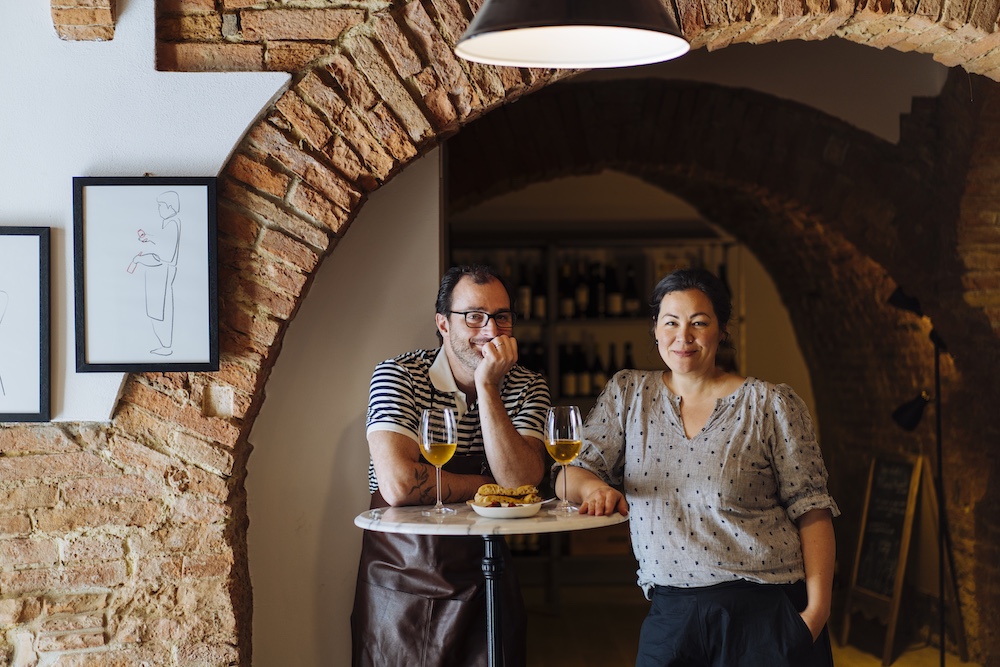
Emiko Davies is a food writer and cookbook author who has lived in Tuscany for over 20 years. She hosts cooking classes and workshops, and runs a natural wine bar, Enoteca Marilu, with her husband. She has published seven cookbooks and her eighth is being published in 2027. Emiko frequently writes about and promotes sustainable travel, and has a travel book on Italy in Hardie Grant’s “Curious Traveller” series that is also being published in 2027. With this year being the tenth anniversary of her first cookbook, Florentine, I met with her at Enoteca Marilu to discuss it and what has changed since it was published.
Florentine is Emiko’s love letter to Florence; Florence was the city where she started food writing, where she started her blog, and where she met and fell in love with her husband. There are sentimental details in Florentine such as the beautiful marbled paper on the cover, and the black and white film photography that was all taken by Emiko. To stay longer in Florence than the initial year that she had originally planned, she enrolled in a darkroom film photography course – and it was during that year that she met and fell in love with her husband and continued to fall in love with Florence.
The impact of overtourism on Florence
However, the Florence that Emiko fell in love with is sadly not the Florence she sees today. In 2026, it is apparent that the effects of overtourism, and particularly food tourism, are destroying Florence. It is a city that Emiko describes as having been subject to mordi e fuggi – hit and run tourism – in recent years. There are many reasons for this, but the increase in Airbnbs is one of the most significant. Historically, tourists would take month-long trips to Florence, such as Lucy Honeychurch in E.M. Forster’s A Room with a View. Nowadays, tourists hit Florence (and other cities, especially in Europe) for only a day or weekend, then run. It is something I am guilty of doing too, but something to be mindful of because of the noticeable impact it has on places and the locals who live there (or who are increasingly being pushed out as they can no longer afford to live there).
Emiko has felt the impact firsthand; when she lived in Florence, she lived on Via dei Neri, which she described as a true cosmos of a street – it had a neighbourhood panino shop, two butchers, a bakery, and other independent shops. She told me how that neighbourhood panino shop, All’Antico Vinaio, has now destroyed the neighbourhood and the tranquil and peaceful cosmos no longer exists. Instead, tourists are queueing up – sometimes for hours – for a sandwich that can now be bought across the world (in the UK, USA, and Dubai). Emiko described it as a trend people post about, missing the real heart and soul of Florence. Rather than queueing for an experience that exists nowhere else in the world, for example to see art at the Uffizi, people are chasing a trend that doesn’t even use unique or artisanal ingredients. If you want an authentic panino – that truly is the quick and simple lunch or snack it is intended to be – check out Emiko’s article with a list of 11 panino shops that are not All’Antico Vinaio. I have been to ‘Ino and Il Cernacchino and would highly recommend both. The la terra panino at ‘Ino was my favourite.
Rediscovering the Florence Emiko Loves
Emiko described the chapters of Florentine as being arranged in the order of places she would take someone who is visiting Florence. Starting with la pasticceria (the pastry shop), then il forno (the bakery), il mercato (the market), la trattoria for lunch for “the equivalent of nonna’s cooking when it comes to eating out”, il maccellaio (the butcher), and in giro (out and about) for crostini, panini, and gelato. She has included an address book at the end, which has some of her recommendations. Interestingly, All’Antico Vinaio was one of the places Emiko recommended in the paninoteche (panini spots) section – from when it was the aforementioned neighbourhood panino shop. When asked if, 10 years on, there is anything she would change about Florentine, Emiko told me that she would remove the reference to All’Antico Vinaio.
Sentimental recipes
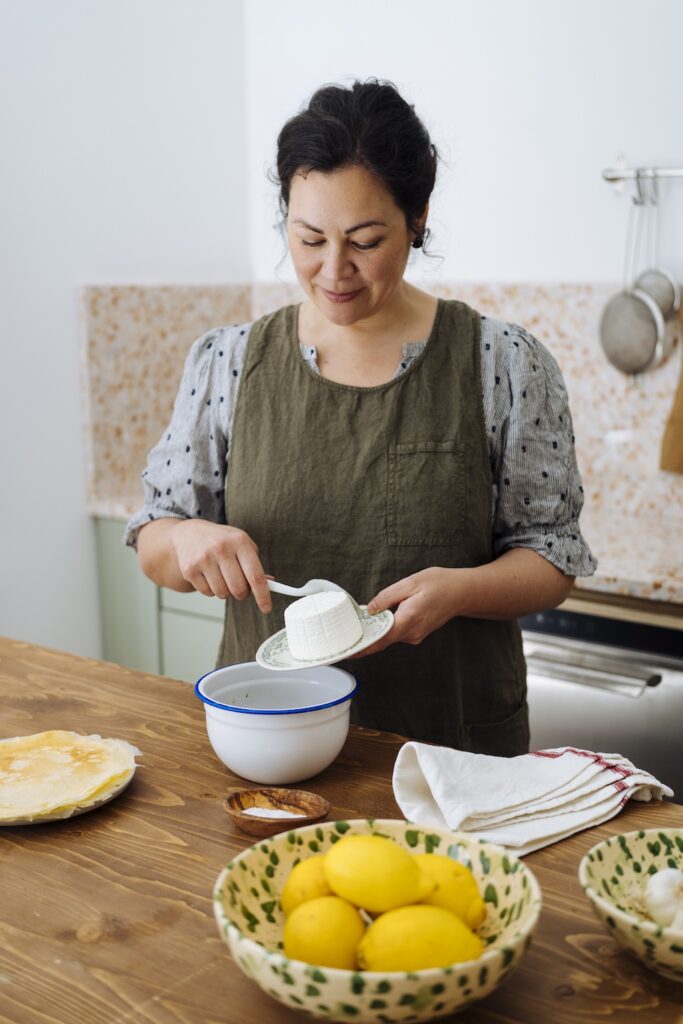
It is clear that Florentine truly is a love letter, and a lot of the recipes and references are deeply personal to Emiko. When asked which recipe in the book is most sentimental to her, she told me that it is the fegatelli – pork liver roasted in lard, a traditional Tuscan dish that is her husband’s favourite. Hearty and seasonal, it is typically served in the winter months. Emiko spoke about the different variations of fegatelli throughout Tuscany – recipes from different towns may use different herbs or small variations.
The recipe for fegatelli in Florentine is based on a recipe from the Falaschi family, the “Master Butchers” of San Miniato who are now in their fourth generation of butchers. Side note: their shop has stunning panoramic views across the Tuscan hillside. Their recipe uses fennel stalks as skewers to hold the dish together. This recipe is a perfect example of local Italian cuisine; seasonal, rooted in tradition, and passed down through generations.
Another sentimental recipe for Emiko is the crostata di marmellata which, coincidentally, is also the recipe most sentimental to me. Florentine was one of the first cookbooks I got in my early twenties, when I didn’t know how to cook, and the crostata di marmellata was one of the first recipes I learned how to make. It tastes so nostalgic and comforting to me and has a special place in my heart.
For Emiko, its sentimentality comes from the pasta frolla pastry, which is based on Pellegrino Artusi’s ricetta b from his cookbook La scienza in cucina e l’arte di mangiar bene (Science in the Kitchen and the Art of Eating Well), about which she initially wrote on her blog. Artusi’s cookbook is beloved across Italy, and he is often described as the father of Italian cuisine. Emiko wrote about his intuitive recipes – if you can even call them recipes, as they read more like stories with guidance on how to make certain dishes – and translated them into modern-day versions.
A Recipe Passed Down Through Generations
When she first visited her husband’s family, she found it curious that they had only one cookbook – a copy of Artusi’s La scienza in cucina e l’arte di mangiar bene – which had been passed from her husband’s nonna to his mother. When she picked up the book, it automatically fell open on the page with Artusi’s ricetta b for pasta frolla – and it is that very recipe, and Artusi’s recipe for the marmellata (jam), that is included in Florentine. So, whether it was fate or not, it is apparent that Florentine truly captures the Florence that Emiko fell in love with.
Regional Italian cuisine
One of the hallmarks of Emiko’s writing is the way she weaves history into her stories. I asked her about her process, and she said that it depends on what the recipe is and whether it is something she has tasted already. She told me that she does often refer to Artusi. However, for her second cookbook, Acquacotta, which celebrates the cuisine of a secret part of southernmost Tuscany known as la costa d’Argento (the silver coast), it was very difficult to find recipes in older books. Instead, she relied a lot on speaking to people and went on research trips to see the Maremma (on la costa d’Argento), where she and her husband would taste local delicacies at sagras – seasonal food festivals that are popular across Italy. There is a sagra in San Miniato, for example, that celebrates the white truffle in November.
Emiko described trattorias in the Maremma as serving the same dishes – often catering to Roman tourists, with dishes such as spaghetti alle vongole. However, sagras showcase truly authentic and traditional dishes or ingredients that are enjoyed and celebrated seasonally. I think that is something special and unique to regional Italian cuisine – each region focuses on seasonality and is a celebration of its landscape; whether that is mountainous or volcanic landscapes providing abundant produce, coastal areas where the focus is obviously on seafood, or landlocked areas where the focus is very much on vegetables and pulses. As I have written about before, one of the things I love most about “Italian” cuisine is the significance of regional cuisine and how, in many ways, Italian cuisine does not necessarily exist. Instead, each region has a diverse and truly unique cuisine.
Experiencing Italy Through Food
Regional Italian cuisine is something that is the focus of the workshops and retreats Emiko offers either at Enoteca Marilu or at other destinations across Italy. She told me of her retreat in Emilia Romagna which, interestingly, she describes as being a very matriarchal region with a strong female energy. I was surprised to hear that, given how patriarchal Italy (and much of the world) sadly still is. At the retreat, guests stay in an old villa run by two Emilia Romagnan sisters. She also hosts an annual Venetian retreat, which began after researching her cookbook on Venetian cicchetti, Cinnamon and Salt. She describes the Venetian retreat as being Cinnamon and Salt but in trip form – guests experience the lagoon and salt marshes on which Venice was built and without which there would be no Venice. She told me that something magical always happens on the retreat.
You can find details of Emiko’s workshops and retreats on her website. Be warned, though – her recent autumnal Sicilian workshop at Anna Tasca Lanza sold out instantly.
Enoteca Marilu
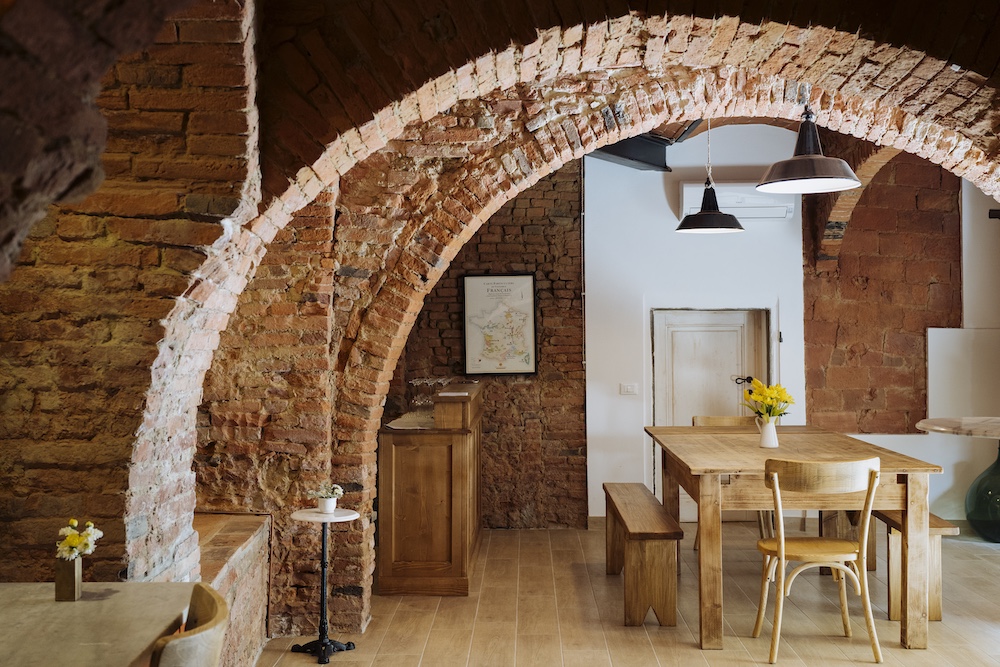
Enoteca Marilu was a dream that Emiko and her husband, Marco, had talked about for years. It truly was a right time, right place moment when they opened the enoteca in 2023. Situated in the charming medieval village of San Miniato, Enoteca Marilu is connected to the aforementioned Falaschi family; the enoteca used to be the kitchen for the butcher shop. Emiko described it as a full circle moment for the enoteca.
Emiko and Marco told me how one of the unique things, and something that is significant to them as business owners, is sustainability. They ensure that the suppliers and businesses they work with for their workshops are also focussed on the environment and sustainability. Enoteca Marilu uses only sustainable energy, and sources and serves only natural wine. You can sense their dedication to promoting sustainable choices, and their respect for local and artisanal ingredients; when I was there Marco had made some bread using an ancient San Miniato grain.
Something like only 1% of the wine produced worldwide is natural and whilst natural winemaking requires more knowledge, and is arguably harder work, the result is a wine that Emiko and Marco describe as being better for the landscape, the wine, and the people drinking it. One of their favourite wines that they serve at Enoteca Marilu is Altura sourced from the Carfagna family at Altura Vigneto. The vineyard is located beneath the Castle of Giglio on the Giglio Island, and the coastal conditions with unpredictable weather make it a difficult harvest.
I would highly recommend a visit to Enoteca Marilu and to San Miniato, perhaps in the autumn to celebrate the prized white truffle.
Thank you to Emiko for her time and for ten years of Florentine. More information about Emiko’s books, workshops, and Enoteca Marilu can be found on her website.