Four August nights, one corkscrew pasta, and a hilltop Sicilian town that truly knows how to throw a party.
Buses begin to arrive at Piazza Libertà shortly before sunset. Families, couples, teenagers, and grandparents step out, all looking for one thing: busiata, western Sicily’s corkscrew-shaped pasta.
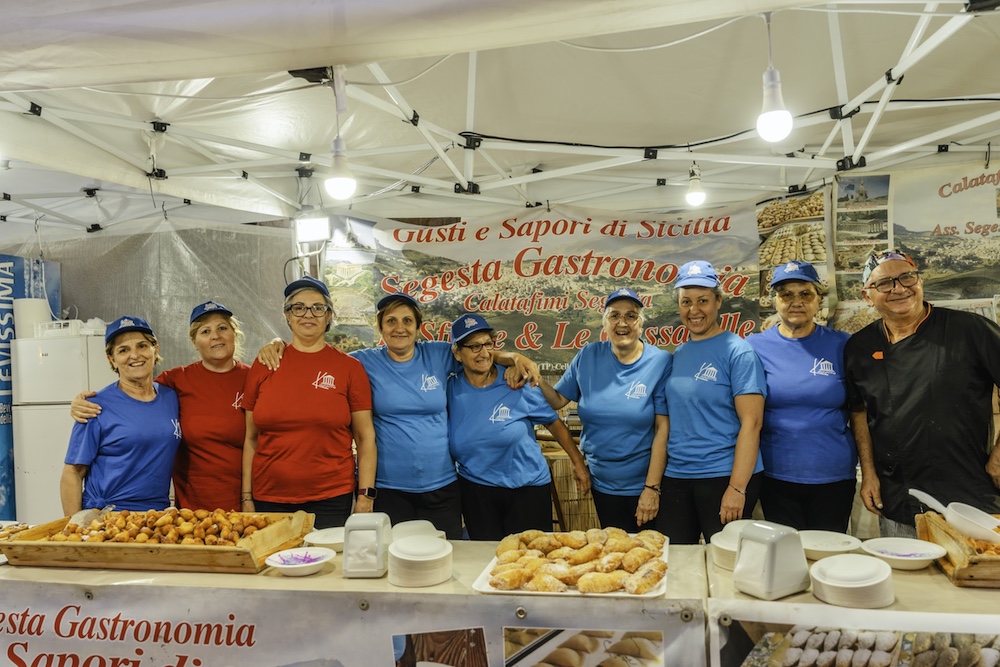
The older men holding court in the piazza pause their conversation long enough to scan the newcomers from head to toe. Before I’ve taken ten steps, the first tented station hits me with the smell of truffle. I say hello to Vito from Extra Bar and eye his perciasacchi busiata (made from an ancient Sicilian wheat), with white-meat ragù, truffle cream, truffle shavings, and pistachio. That smell sets the tone for my first night at western Sicily’s favorite pasta festival.
I walk into the main square, pass the big welcome sign, and head to Tazze Pazze, a local bar where everyone knows your name. I order the Salemi Spritz, made with MandaRita, a local mandarin liqueur, instead of Aperol. With my cup in hand, I hear instruments starting up. I step to the door just as the Sud Street Band strikes up Gloria Estefan’s “Conga,” and the whole crowd stops to dance, film, and sway. As a Latina who fell head over heels for Italy, I couldn’t stop smiling. A Miami anthem in a Sicilian hill town? Kismet. Dinner can wait one more song.
The first time I visited Salemi, in July 2025, everyone enthusiastically asked me the same question: would I be here for the Sagra della Busiata? “It’s the best,” they told me, beaming. “You have to come.” So I flew home to the US, and two weeks later I was back. They were right.
A Sicilian Hilltop Town Comes Alive
Every year in early August, the historic center of Salemi, located in the province of Trapani, hosts the Sagra della Busiata. The 2026 edition took place from August 4th to 7th and marked the festival’s 22nd year. Organizers estimate that approximately 40,000 people attended over the four nights.
Since 2025, it has received Italy’s national “Sagra di Qualità” (Quality Festival) label, which is awarded to food festivals that promote authentic local products, preserve regional traditions, and are organized by the community.
Salemi sits among the hills of the Belìce Valley and belongs to I Borghi più belli d’Italia, the association of Italy’s most beautiful villages. By day, Salemi can look like any quiet Sicilian town. But on festival nights, the whole historic center turns into a food quest, map and all.
A Pasta Named After a Grass Stem
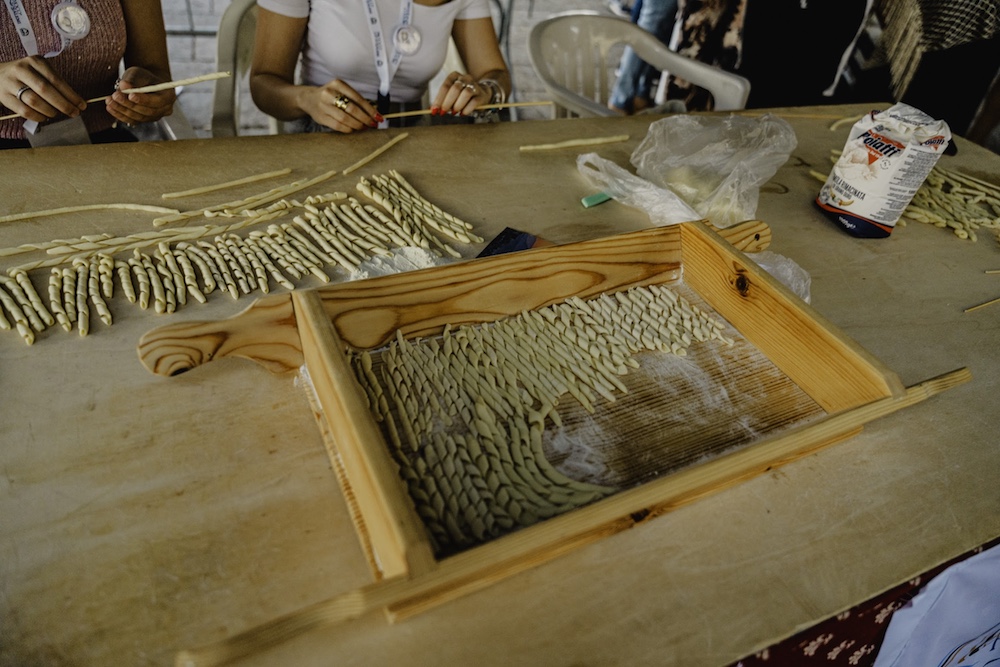
Busiata is western Sicily’s signature fresh pasta: long, thin strands twisted into tight corkscrews, like an old telephone cord. That shape is no accident. Every spiral is a little pocket built to trap sauce.
The name comes from busa, the Sicilian word for the stiff stem of a wild grass called ampelodesmos. Generations of cooks wrapped a strip of dough around the stem, rolled it under the palm, and slid it off. Today, many makers use a thin iron or wooden rod instead, but the gesture remains the same.
Many trace busiata to Sicily’s Arab period, and today it holds a place on the region’s official list of traditional foods.
Its classic partner is pesto alla trapanese: almonds, garlic, fresh tomato, basil, and olive oil, pounded together. But as I discovered, Salemi doesn’t stop at the classics.
A Treasure Hunt Through the Borgo
You can grab a map flyer or follow the big map posters around town. Twelve busiata stations are tucked into piazzas, courtyards, and cloisters across the historic center, each with its own recipe. Some draw on the sea, some stay inland, and some go somewhere you’d never expect.
That’s deliberate. “Salemi’s busiata stands out for its spirit of experimentation,” says Fabrizio Internicola, a destination and urban regeneration manager and one of the organizers of Salemi’s Sagra della Busiata.
“Every stand has the opportunity to tell a different culinary story, and every edition can bring new discoveries.”
The hunt for your favorite busiata leads you down winding lanes into tucked-away piazzas, shaded by trees and paved with neat cobblestones. It’s a pilgrimage, except the devotion is to sauce, and the route shows you corners of Salemi you’d never find otherwise.
This year, my second, I took it slower, choosing my flavors and spreading them across all four nights. Then I met two American visitors who had made it through all 12. I bowed to their commitment.
A Taste of Western Sicily
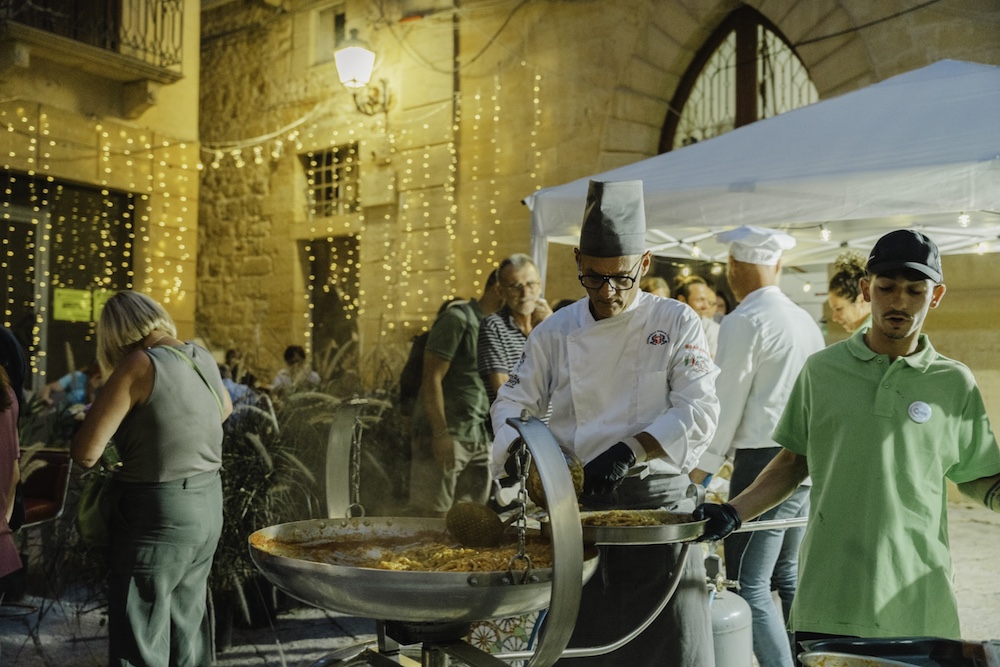
Look closely, and nearly every plate reads like a map of western Sicily: black pork from the Nebrodi mountains, sweet red onions from Partanna, ancient perciasacchi wheat, almonds, swordfish, and local wine to wash it all down. As per Internicola: “The quality of the ingredients is fundamental, but so is the creativity with which they are combined.”
My favorite came from Kuddura, in Piazza Alicia: busiata with pulled black Nebrodi pork and Partanna’s sweet DOP red onion. Slow-cooked and tender, it was like chicken soup for the soul, just with pork and carbs. Two stations even made their busiata from percia sacchi wheat, and two others offered gluten-free versions.
Then come the crowd favorites; you can spot them by the long lines.
- Fusion BBQ Lab: wild boar ragù with rosemary-toasted breadcrumbs
- Az. Agricola Caradonna: perciasacchi busiata with cherry tomato sauce and beef meatballs
- Pititto: white grouper ragù with zucchini cream and toasted almonds
- La Giummara: swordfish with eggplant and toasted almonds
By the last night, my belly was full, and my head was spinning. Near Palazzo Monroy’s station, by Salemi’s panoramic viewpoint, the Mess Around Band had the whole piazza dancing to “Great Balls of Fire” and a string of Italian favorites. Around us, people devoured bowls of octopus and squid busiata, and the gelato stand next door sold out before the night was over.
Behind the Plate
“Ultimately, the greatest achievement is what happens around the plate,” says Internicola.
That takes a whole town. “Every year, restaurateurs come together with associations, local producers, and the administration to discuss organization and how to continuously improve,” says Alessandra Cascia, co-owner of Palazzo Monroy. “The work begins months in advance.” Her hope is simple: “that more and more people will come to love Salemi and its alleyways as much as we at Palazzo Monroy do.”
That love for Salemi shows up in unexpected places. One of my favorite surprises was inside Gioielleria Lo Castro, a family-run jeweler open since 1847. For the festival, the team created Preziosa Salemi, a photographic journey pairing their pieces with symbols of Salemi: Amlé with busiata, Oro di Sciacca with St. Joseph’s breads, and Maria e Luisa Jewelry with the Chiesa Madre. It was a beautiful way to weave together the threads that make up Salemi: its history, its craftsmanship, and its food.
In the Glass
Busiata is the star, but it has a strong supporting cast. Most plates come with a drink, so a glass of local wine is part of the deal, and pairing is taken seriously here. “For us, the Busiata Festival is all about harmony: the pasta, the sauce, and the wine working together,” says Anabel Gandolfo of Nino Gandolfo Winery. For example, Palazzo Monroy poured the Bianco Gandolfo with its seafood busiata.
Ask Gandolfo what to drink with classic pesto alla trapanese, and she’ll say a Nero d’Avola, Sicily’s signature red grape. It might surprise anyone who reaches for white with pesto, but a fresh, fruit-forward red stands up to the garlic and sweet tomato. For seafood, a rosé or a frizzante is another light, lively option for a hot August night.
When the pasta is done, the evening isn’t. Grab a sugar-dusted sfincia, then find the Alicia Liquori stand. This small Salemi family business, founded in 2003 and run today by Rosalba Calia and her daughter Mariapia, makes Amaro Monte Polizo and a range of liqueurs.
The name comes from Monte Polizo, the hill outside town where archaeologists uncovered an Iron Age Elymian settlement. The spiral logo is based on a brooch found there, an ancient swirl right at home at a busiata festival, and some of the 30-plus herbs in the amaro grow wild on that same hillside. As Daniela Muraca (Social Media Coordinator) puts it, the experience “begins at the table and culminates in the glass.”
I took my limoncello in Piazza Alicia, glass cold in my hand, the Norman-Swabian castle glowing under the floodlights. Music drifted over from the stage set among the ruins of the old Chiesa Madre, and people lingered over their last plates and drinks, in no hurry to go home.
Passing It On
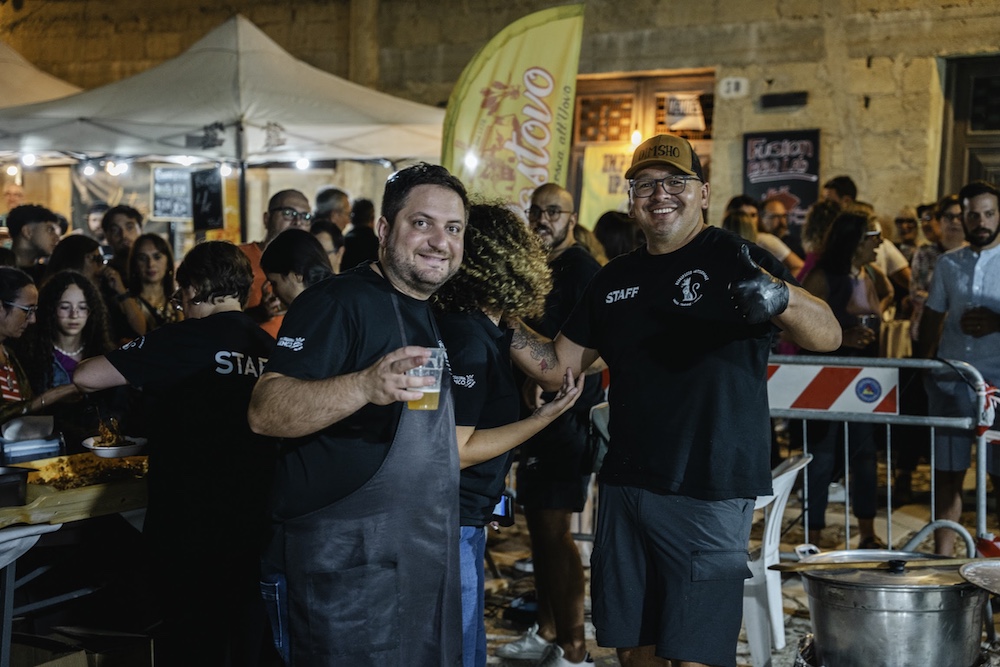
In Salemi, busiata is a point of pride, and pride gets passed down.
At home, the grandmothers who still make it often reach for a real busa; others use a wooden or iron rod. Many homemakers of that generation still cook everything from scratch, while younger women juggling studies, first jobs, and babies tend to buy their busiata fresh. For Cascia, Pastovo’s shop is the go-to. Beyond Sicily, factories now make busiata almost everywhere.
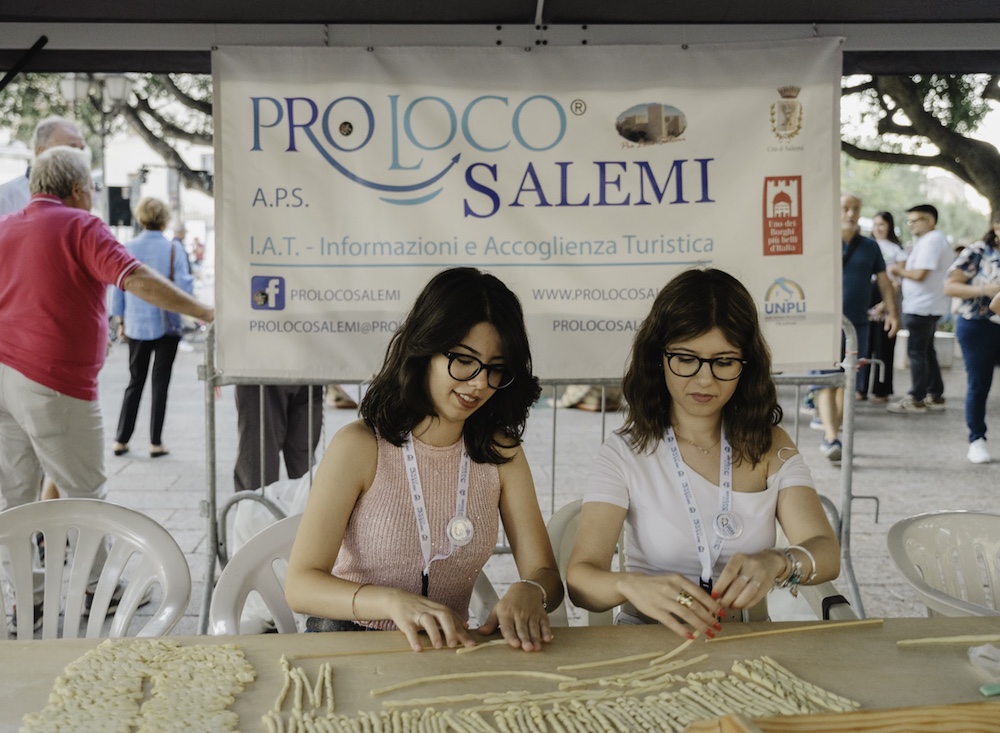
That is exactly why the handmade version matters here. “We want young people to learn the traditional techniques of making busiata by hand,” says Internicola, while giving them “a reason to feel proud of their heritage and to carry it forward.” For him, “preserving the tradition means respecting its origins while creating the conditions for it to evolve.” At the Pro Loco’s busiata workshop, nonnas and young people rolled dough side by side while children pressed in for a closer look.
The tradition welcomes newcomers too. Escape in Sicily offers the ‘Mpastamo Cooking Class in Salemi, led by a local chef, so you don’t have to wait until August to learn the twist yourself. I finally got to twirl the dough around the rod myself during their class, and it was special to take part in a tradition passed down through generations.
Room at the Table
The next morning surprised me. Walk through Salemi after a festival night and you’d never guess thousands of people ate their way through these streets just hours earlier. The stone is swept, the piazzas are quiet, and everything is back in its place. As someone who now owns a home here, I felt proud to be part of a community that pulls off something this big, this smoothly.
That pride is the real secret ingredient, but it’s never closed off. Every year, the festival’s International Folklore Festival brings Sicilian folk groups together with dancers from abroad. This year, the Compañía Folclórica de Valdivia traveled from southern Chile and filled the piazza with color and music. It says a lot about Salemi: fiercely proud of its own traditions and always making room at the table for someone new.
That welcome extends to those of us who stay. Each summer, I hear more languages in the piazzas, and some of those voices now belong to neighbors.
The Sagra della Busiata returns every year in early August. To learn more, follow @sagra_della_busiata_salemi or visit Visit Sicily’s festival page.
Author