
St. Francis, San Francisco and the Italian Story of Cioppino
Before an Italian community ever arrived on the docks of San Francisco, Italy was already present in the city’s name.
In 1776, during the Spanish colonization of California, the Presidio of San Francisco and Mission San Francisco de Asís—today known as Mission Dolores—were founded. Both were dedicated to St. Francis of Assisi, whose name would remain forever connected to the history of the city.
When Italy Arrived in San Francisco
Almost a century later, another Italy would arrive on the shores of the same bay.
Between the 19th and early 20th centuries, San Francisco welcomed a large Italian community, with a strong Ligurian and Genoese presence. Many immigrants worked in commerce, restaurants and fishing, helping to build the culinary culture that still characterizes the city today.
It was in this environment that cioppino was born.
It is not simply an Italian recipe transferred to America. It is something more interesting: an Italian memory transformed by a new place.
Its most obvious relative is the Ligurian ciuppin, a traditional coastal fish soup. But cioppino is not ciuppin transported unchanged across the ocean. In San Francisco, that memory encountered the Pacific, its fishermen and whatever the sea offered each day.
Local fish, shellfish, shrimp and, above all, Dungeness crab—the large Pacific crab that became one of the dish’s most representative ingredients—found their way into the pot. Everything came together in a broth of tomato, garlic, wine and chili pepper.
It was a simple preparation, born around work and the availability of the day’s catch.
The Origins of Cioppino
Even the earliest written traces reflect this practical nature.
The name and recipe for cioppino appear in San Francisco sources from the early 20th century. Different traditions connect its name either to the Ligurian ciuppin or to the fishermen’s practice of sharing whatever catch remained at the end of the day.
The exact origin of the word remains debated.
Perhaps it is precisely this uncertainty that makes cioppino even more interesting.
Because immigrant cuisine rarely follows a perfect line.
Those who leave home do not carry an entire cuisine with them. They carry gestures, flavors, words and memories. Then they adapt them to what they find.
The ingredients change. The sea changes. The people around the table change.
And slowly, something is born that belongs to both worlds.
Italian in Memory, American in Identity
Cioppino is Italian in memory, American in its identity.
It is one of the most beautiful expressions of Italian-American heritage: not the preservation of a tradition under glass, but the ability of a tradition to continue living precisely because it changes.
And there is another coincidence that makes 2026 particularly significant.
This year marks 800 years since the death of St. Francis of Assisi in 1226. The year 2026 also marks 250 years since the events of 1776 that led to the birth of the United States as an independent nation.
Two different anniversaries, two stories that should not be forced together. Yet through a city overlooking the Pacific, they allow us to observe something deeply human: how names, people, cultures and flavors can travel across time and oceans.
Perhaps that is why today, when I look at a bowl of cioppino, I do not simply see a fish soup.
I see a Liguria that leaves, a new continent that welcomes, a sea that changes a recipe and a community that transforms a memory into something new.
Not, then, an Italian recipe preserved in America.
But an American recipe that still preserves an Italian memory.
Two shores. One memory. And a new tradition born somewhere in between.
My Version of Cioppino
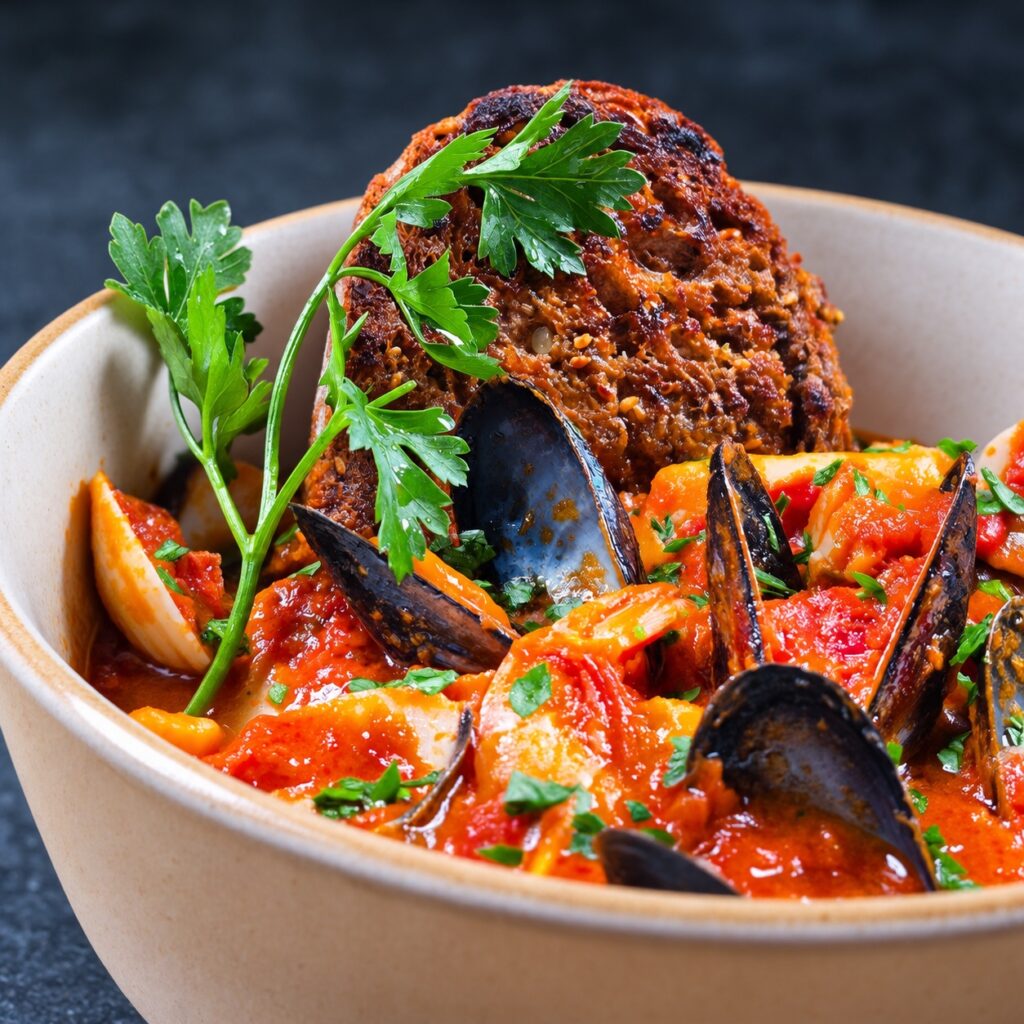
This version is designed to be prepared in Italy as well, while maintaining the elements that define the dish: tomato, wine, garlic, chili pepper and an assortment of fish and seafood.
Ingredients | Serves 4
- About 800 g (1¾ lb) mixed fish and seafood
- 300 g (10½ oz / about 1¼ cups) tomato passata or finely crushed tomatoes
- 200 g (7 oz) mussels
- 200 g (7 oz) clams
- 8–12 shrimp
- About 300 g (10½ oz) firm-fleshed fish, such as monkfish, gurnard or scorpionfish
- 2 cloves garlic
- ½ glass (about ⅓ cup / 80 ml) dry white wine
- Fresh or dried chili pepper, to taste
- Fresh parsley
- Extra virgin olive oil
- Salt
- A few ladlefuls of fish stock, if needed
- Toasted rustic bread, for serving
Preparation
In a wide pot, gently heat the extra virgin olive oil with the garlic and chili pepper, taking care not to let them burn.
Add the tomato and cook for a few minutes, then pour in the white wine and allow it to reduce. Add a little fish stock and simmer until you have a fragrant broth that is not too thick.
Next, add the fish and seafood according to their cooking times: begin with those that require more time, followed by the mussels, clams, shrimp and more delicate ingredients.
It is important not to overcook the fish. The cioppino should remain rich in broth, with the individual ingredients still recognizable.
Season with salt and finish with fresh parsley and a drizzle of extra virgin olive oil.
Serve piping hot in a wide soup bowl, with the fish clearly visible and toasted bread on the side—perfect for soaking up the tomato and seafood broth.
Wine Pairing
Old Vine Zinfandel | California
For cioppino, I would choose a wine that, like the dish itself, has traveled through California’s history.
A California Zinfandel, preferably from old vines, is a less obvious choice than a white wine, but a particularly interesting one. Its acidity stands up to the tomato, while its ripe fruit and spicy notes complement the chili pepper, garlic and richness of the broth.
It has structure, but a good Zinfandel—balanced and not excessively alcoholic—can accompany the dish without overpowering its flavors of the sea.
It is also a choice that completes the story.
Cioppino was born from a Ligurian memory on the California coast; Zinfandel is one of the wines that most vividly tells the story of that same land.
Together, they become a small expression of Italian-American identity.
Serving temperature: 15–17°C / 59–63°F.