
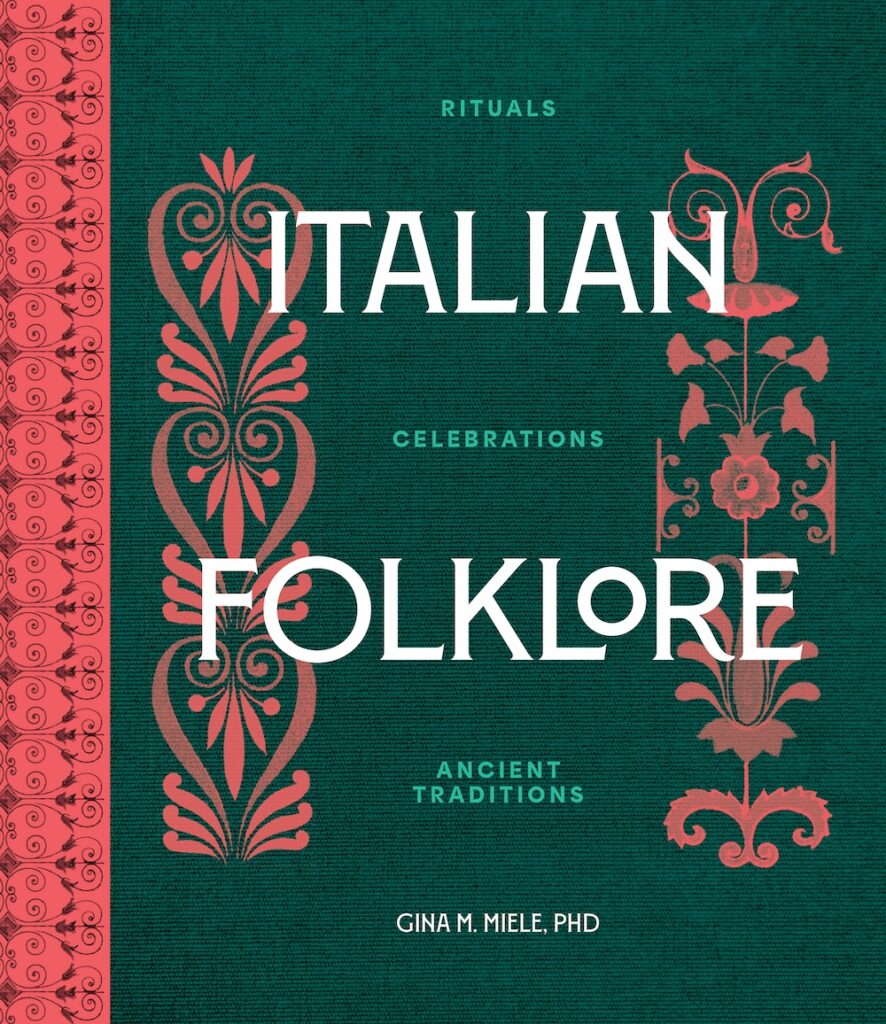
Italian Folklore: Rituals, Celebrations, and Ancient Traditions by Dr. Gina M. Miele
Growing up as a second-generation American, I was lucky to have a family that shared customs, stories, art, and culture from their homeland. I remember stories of malocchio, the cornicello, the saints. We honored and celebrated, but we rarely knew why. It just was something our grandparents passed down.
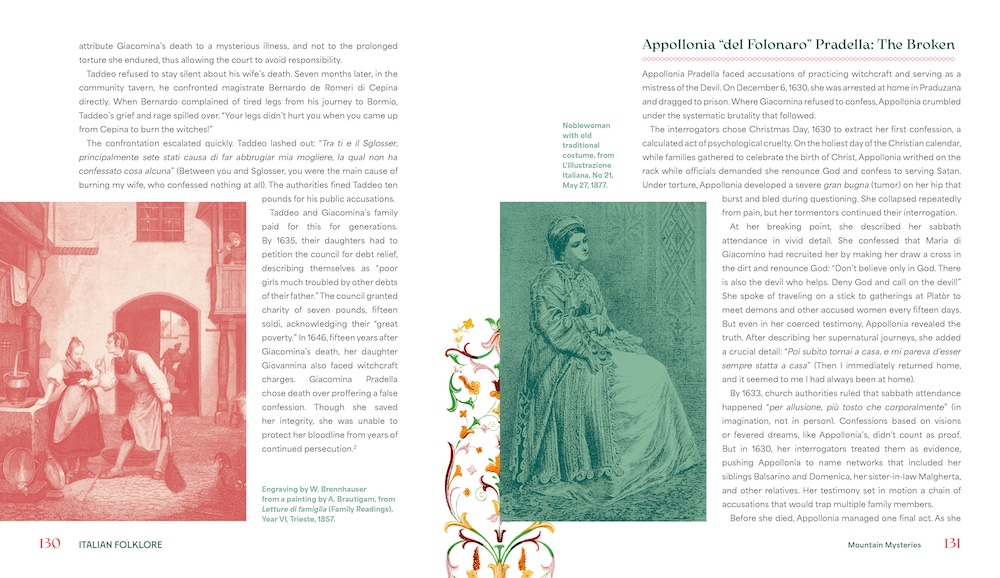
Italian Folklore: Rituals, Celebrations, and Ancient Traditions (Dr. Gina M. Miele) has given me insight as to the who, what, and why of these customs. Miele not only recounts charming superstitions and colorful festivals, but she also goes into their histories and how they have survived and evolved over the years. The folklore, the customs, the rituals are a glue that hold the Italian identity together while they have adapted to social, religious, and political changes.
Why Italian Traditions Endure
Good examples of this are the seasonal festivals. Once agrarian, spring fertility rites and fall harvest festivals evolved to include Christian symbolism that, to this day, survives. Towns all over Italy incorporate their patron saints into celebrations of the town’s agricultural gifts. My cousin, who lives in a small town near Pescara, told me that during Loreto Aprutino’s annual
festival to San Zopito, they lead a bull through the town and bring him to the saint’s statue. If he kneels before the statue, they will have a bountiful crop and harvest. These festivals are a cord that knit together religious devotion, local pride, and performative spectacle.
One Country, Many Folklore Traditions
Of course, one must keep in mind that Italy is a young country and was once a peninsula of separate city states. Miele repeatedly uses regional comparisons to demonstrate how diverse and interlinked its folklore is. She highlights regional differences in ecological, economic, and historical rituals in addition to the seasonal cycles, holy celebrations, and rites of passage.
Miele delights in regional differences. The Alpine carnivals of the north, the mystic processions of the Mezzogiorno, the pastoral transhumance of the plains, and the maritime celebrations of the coasts, all get their due. For example, in Abruzzo and Umbria, music and symbolism are tied to the hills, to pastoral life. In Campania, towns on the coast include rituals for fishermen’s protection, sea processions, and devotions to specific patron saints linked to seafaring. And, on Sicilia and Sardegna, you’ll find influences that are Spanish, French, Arabic, and African.
Miele’s tiled approach demonstrates national patterns without erasing local textures. It also raises a subtle but important point: folklore can unify a nation while remaining local.
One interesting theme Miele follows is that the rituals perpetuate, in a sense, the politics of not only belonging but also of social hierarchy and gender roles. The processions of saints are an expression of faith, yes, but they are also a unifying event for the town that often feature the town’s leaders while ordinary citizens follow behind. It is a show of who performs and why, and who participates through watching and why.
The Hidden Power of Women
Included in that are the gender roles. Men may hold the patriarchal power, but the women held the invisible power, the knowledge. They were the ones who helped people through birth, illness, death, and other important life passages. As midwives, mothers, herbalists, healers, and keepers of secrets, they passed that knowledge down through generations.
The Evil Eye and the Cornicello
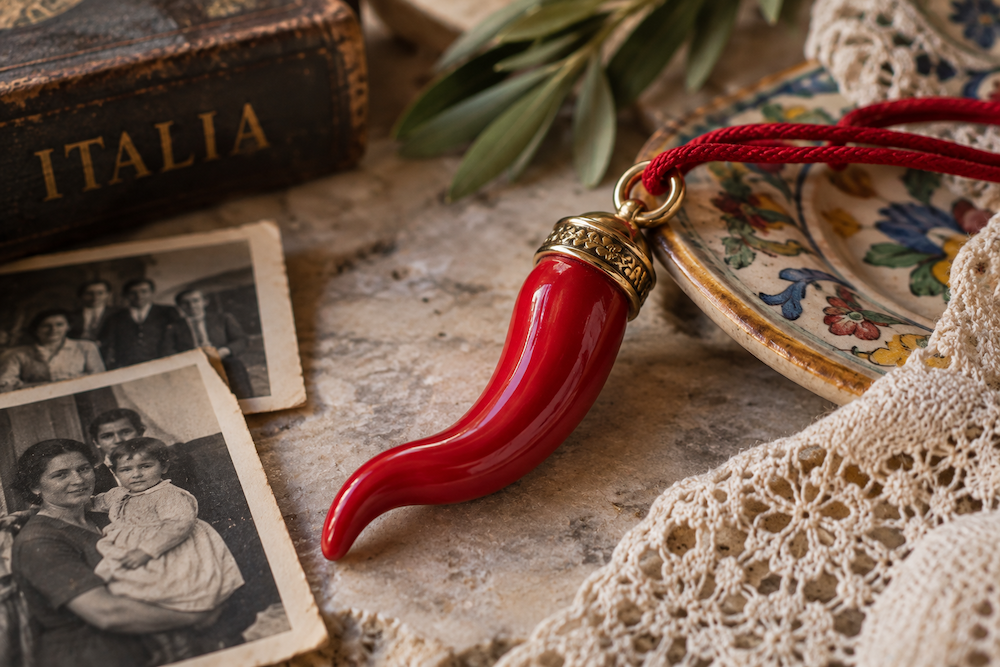
Miele offers a fascinating look at the secrets of the charms and apotropaic acts—the use of amulets and other symbolic objects—as protection against the evil eye, il malocchio. This particularly interested me because of all her themes, it was the one about which I knew the least. She ties pre-Christian beliefs with Catholic practice, documenting how pagan symbolism survives beneath holy observance. Examples include protective charms and rituals performed in domestic spaces and at village thresholds, and seasonal customs that enact humankind’s negotiation with natural forces.
When I was a child, many of my cousins and Italian friends wore cornicello, the red horn. For me, it showed we were Italian; I didn’t realize the symbolism behind it. My parents didn’t allow me to buy one, for whatever reason. I didn’t realize that you cannot buy one for yourself, that it must be a gift from another for its powers to work. Instead, I wore the scapular, a length of cord with two rectangles containing religious pictures on either end. The scapular was the religious iteration of the more pagan/secular cornicello.
The Malocchio in Family Memory
One of my favorite book series has a character, Grandma Bella, who gives the evil eye to anyone who does something she doesn’t like. I point this out because the series pokes fun at il malocchio and the fear Grandma Bella’s nemeses have of it and of her. But, il malocchio is and was a real thing. According to family lore, my grandmother once cast the malocchio on a doctor who refused to treat her oldest son who then passed away. She wished he would get hit by a train….and my cousins tell me that it actually did happen, much to Gram’s delight.
Of course, in addition to the preventative and cursed methods, Miele also discusses ways Italians discover if they’ve been cursed and ways to get rid of the curse. Throw a knife across the room to break the eye. Cut oil drops with scissors. Chant words and formulas. Many have been passed down; many have been forgotten.
Folklore as Memory
Memory plays an important part in all of this as it preserves the knowledge of women (and other community members) whose traditions were often passed down orally rather than through official institutions. Stories, rituals, and traditions passed down through generations are ways that people remember their ancestors and maintain a sense of belonging.
If you remember, at the beginning of this article I mentioned that we honored and celebrated much of the Italian way because it was what our grandparents passed down. I think that therein lies much of the strength of this book; Miele uses short, engaging tales to introduce us to Italian folklore and traditions. The stories still give readers a sense of the history, beliefs, and values behind these traditions and keeps them personal, understandable, and accessible.
Ultimately, what Miele’s book helped me understand is that these traditions were never simply things we did because our grandparents told us to do them. They were pieces of a much larger story—of survival, belief, family, place, and identity. The stories and rituals that they passed down connected me to people and places I had never known firsthand, even when I didn’t understand their meaning.
In that sense, folklore is more than superstition or old custom; it is memory made visible. Miele’s book gave me a way to look at the cornicello, the saints, il malocchio, the festivals, and all those things we simply “did” growing up and see them differently. I may still not know why my grandparents did everything they did, but now I understand that in remembering and retelling these stories, we are keeping a little bit of them—and of where we came from—alive.
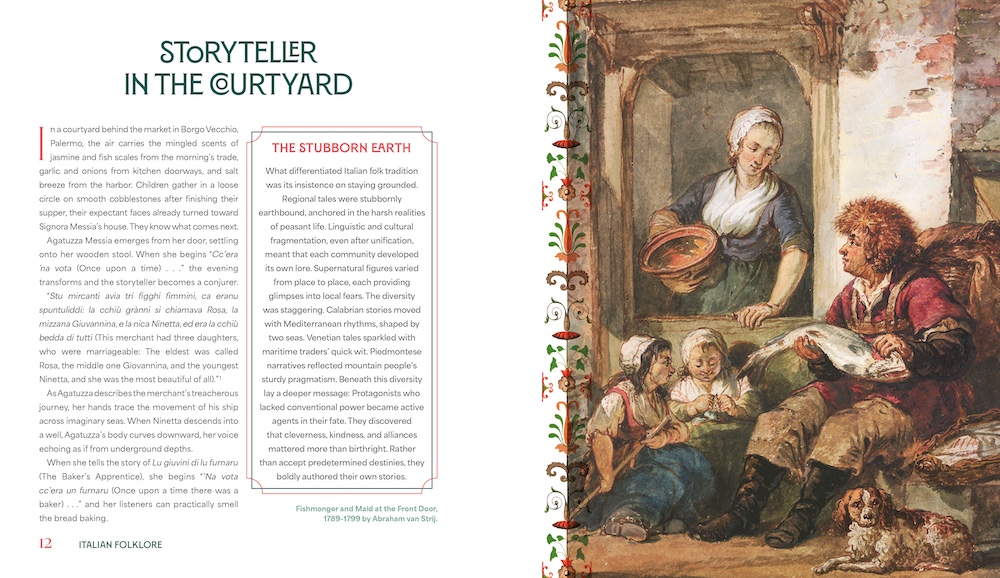
Buy Italian Folklore: Rituals, Celebrations, and Ancient Traditions:
Amazon: https://a.co/d/04W7pIAE
Target: https://www.target.com/p/italian-folklore-by-gina-m-miele-phd-hardcover/-/A-1010393882
Google Books: https://books.google.com/books/about/Italian_Folklore.html?id=qWPV0QEACAAJ