
Imagine walking among rows of vines stretching as far as the eye can see. Imagine the scent of fermenting grape must filling the narrow streets of a small village. Imagine a silent castle overlooking a countryside painted red and gold.
In autumn, Italian Wine Routes become even more beautiful and atmospheric. These officially certified itineraries take visitors on a journey to discover countless treasures of art, culture and above all food, with a particular focus on wine.
With cellars and bars where you can stop to taste the best-known wines or discover new labels, the 150 Italian Wine Routes create an alternative map of Italy, highlighting a tradition whose roots stretch back thousands of years.
Let’s set off on a journey through five of the most fascinating ones, from the northern mountains to the mediterranean islands.
The Royal Wine Road of Turin
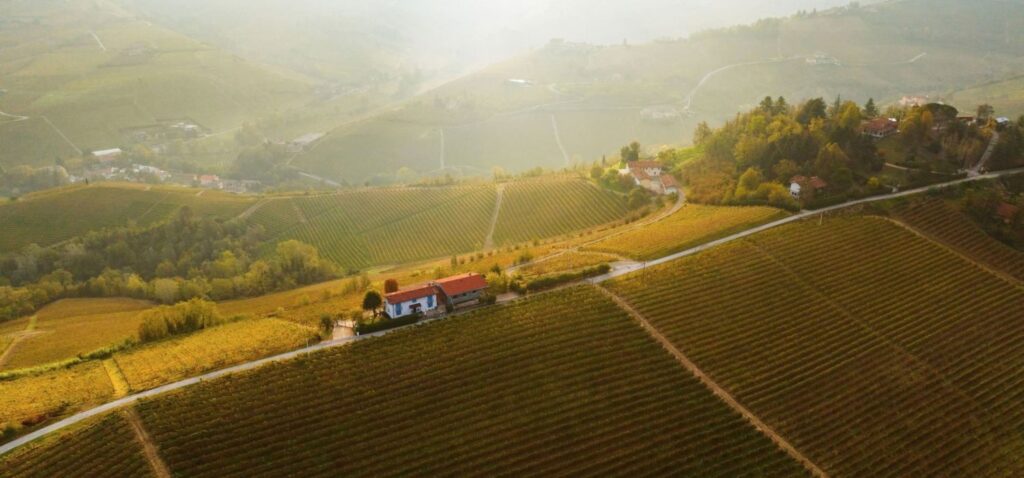
In Piedmont, home to some of Italy’s most highly regarded wines, there is a route winding through lavish royal residences, ancient fortresses and 17th-century wineries. More than 600 km of itineraries across the province of Turin make up the network known as the Royal Wine Road of Turin, to explore on foot, by car, bicycle or even on horseback.
Along one of the longest Italian Wine Routes travelers can discover more than a hundred labels made from as many as 45 traditional grape varieties.
This vast and richly varied area can ideally be divided into four zones.
Canavese is home to Masino Castle, overlooking the Ivrea Moraine Amphitheatre. The Erbaluce di Caluso DOCG, a sophisticated white grape variety, is cultivated here.
Carema is a charming village almost on the border with the Aosta Valley, where winemakers practice heroic viticulture on pergola-trained terraces to make a rare Nebbiolo wine, the Carema DOC.
Among the magnificent landscapes of Val Susa and the Pinerolese area, high-altitude viticulture is quite common to grow rare native grape varieties such as Avanà and Becuet.
Finally, the hills around Turin, with their immense artistic treasures such as the Basilica of Superga and Villa della Regina, are still the home of some red wines once particularly loved by the Savoy rulers.
The Sagrantino Wine Route
Central Italy offers an extraordinary combination of landscapes, cultural heritage and food and wine traditions. While Tuscany may be the first region that comes to mind in this context, Umbria is certainly no less remarkable.
Among green hills and medieval villages that have remained largely intact over the centuries, a unique red wine is born, and the Sagrantino Wine Route is the best way to discover this heritage in all its facets.
Family-run wineries offer more intimate experiences, allowing visitors to get a close look at traditional production methods, but there are also larger estates where major producers operate.
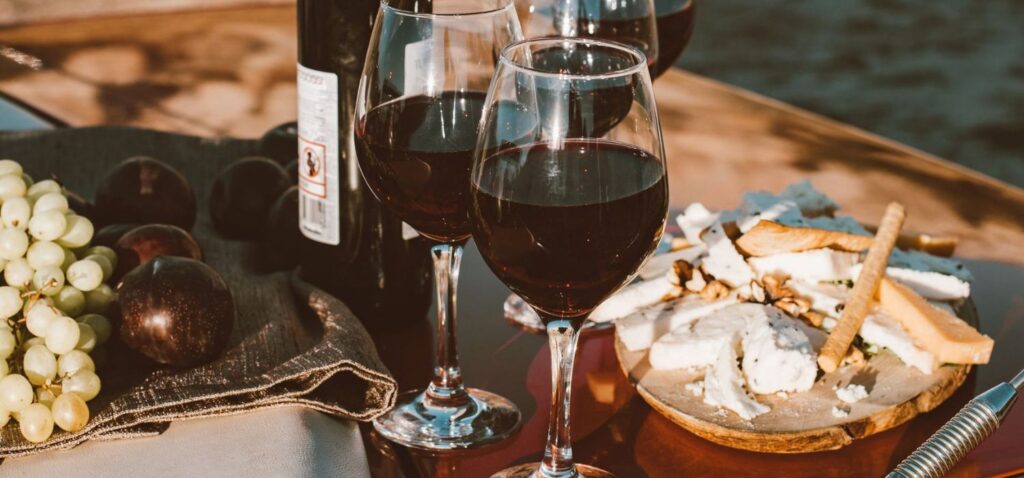
In every case, the undisputed star is Sagrantino di Montefalco DOCG, one of the world’s most structured and tannic red wines. It is perfect for those who enjoy bold flavors and wines with a high alcohol content. For a truly complete tasting experience, this wine should be paired with some of the many local specialties, including excellent Umbrian cured meats and cheeses, as well as pasta dishes with hare or wild boar ragù.
The Sagrantino Wine Route is also particularly easy to explore. It is a loop itinerary in the province of Perugia that passes through five fascinating medieval towns: Montefalco, Bevagna, Gualdo Cattaneo, Castel Ritaldi and Foligno. Distances are short, with wineries located no more than half an hour’s drive from one another, while the journey itself is wonderfully scenic, winding through vineyards that take on spectacular colors in autumn.
The Aglianico del Vulture Wine Route
Southern Italy also has an ancient winemaking tradition and numerous itineraries for tasting the best local wines, but Basilicata in particular is home to a one of the less known Italian Wine Routes, a true hidden gem for discerning wine lovers.
In a region with so much to offer but still largely untouched by mass tourism, travelers can follow a mysterious and wild route along the slopes of Vulture, an extinct volcano. Here, vineyards lie at an unusually high altitude for southern Italy, reaching up to 700 meters above sea level, while the volcanic soil gives the wine distinctive aromas.
This is the land of Aglianico del Vulture DOCG, a complex and full-bodied red wine. Basilicata is also a land that does not believe in rushing. Here, time and the seasons take their natural course, and so does the wine, which can age beautifully in the bottle for up to 30 years.
Among forests and volcanic lakes, wineries are often housed in cavities carved into tuff or inside caves. Rionero in Vulture and Barile are at the heart of production, but the route includes other atmospheric and important stops, such as Venosa, birthplace of the Roman poet Horace, the magnificent Norman castle of Melfi, and the Cathedral of Acerenza, where the legend of Dracula meets none other than the myth of the Holy Grail.
The Etna Wine Route
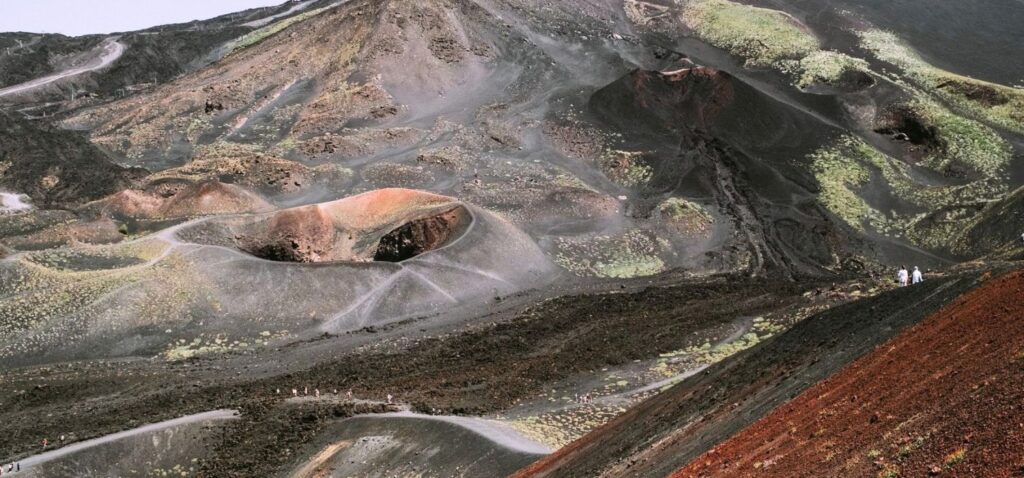
Let’s now move to Sicily, to the foothills of another volcano, this time one that is very much still active.
Mount Etna is a unique place where the white of the snow, the black of the volcanic soil and the blue of the southern sky come together to create an extraordinary ecosystem, and a landscape that seems from another world. Among chestnut groves alternating with terraces clinging to the volcano’s slopes, the locals cultivated grapes already thousands of years ago, on a unique terrain shaped by lava flows over the ages. To make this itineray even more unique among the Italian Wine Routes, there are two UNESCO World Heritage sites: one is Mount Etna itself, and the second is the dry-stone terraces.
Grape varieties such as Minnella and Nerello Mascalese are among the treasures of the Etna Wine Route, producing wines that have only begun to attract widespread international attention in recent years. Some of these grape varieties, however, are more than 150 years old and have the remarkable distinction of having survived the phylloxera epidemic of the late 19th century thanks to the nature of the volcanic soil.
The route forms a loop around Mount Etna. On the northern slopes, you will find the oldest vineyards, many of them centuries old, as well as some of the most prestigious wineries. Linguaglossa, Castiglione di Sicilia and Randazzo are excellent bases for exploring the area. On the sunny southern slopes, around the villages of Viagrande and Trecastagni, more fruit-forward red wines are produced. The eastern slopes overlook the Ionian Sea and are home to Etna Bianco Superiore, which can only be produced in Milo.
A particularly atmospheric way to experience this route is aboard the Etna Wine Train, the historic narrow-gauge railway that still runs along the volcano’s slopes.
The Cannonau Wine Route
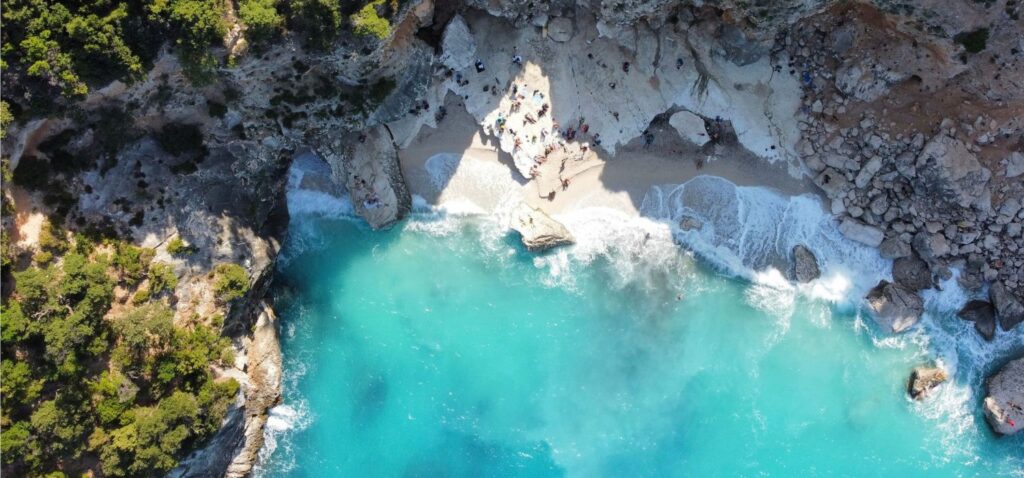
Another Italian Wine Routes that definitely is worth a visit lies in the heart of Sardinia, a part of the island that is less glamorous but more authentic. Here, landscapes, anthropology and excellent wines come together. We are between Nuoro and Ogliastra, among historic villages such as Mamoiada and Oliena.
This is the land of the Mistral and of the mysterious Mamuthones, the ancestral masks worn during a Carnival tradition whose origins reach back to the Nuragic age, almost 4,000 years ago.
Between the sea and the mountains, among the millenary Giants’ Tombs and the even older domus de janas, the Cannonau Wine Route offers the chance to take a true journey through time as well as through local flavors. Those hunting for the most interesting wines can enjoy tastings and even meals with shepherds, for an immersive experience of local culture that is impossible to replicate elsewhere.
Cannonau is, of course, the signature wine of this part of Sardinia. It is a red wine with fruity aromas and, according to some theories, its antioxidant properties may even be one of the secrets behind the unusually long lifespans of Sardinia’s inhabitants. Not everyone knows that Sardinia is one of the very few Blue Zones in the world, meaning an area with an exceptionally high concentration of centenarians.
The Cannonau Wine Route mainly unfolds across three geographical areas, stretching from the sea to the mountains of the interior.
The northern area, around Nuoro and Barbagia, is the mountainous zone dominated by the peak of Gennargentu.
Mandrolisai lies in the central part of the island. It is the geographical heart of Sardinia, where vineyards grow surrounded by cork oak forests.
Further south lies Ogliastra, where plateaus with sheer cliffs alternate with hills descending toward a stretch of coastline of extraordinary beauty. Here, the sea breeze gives Cannonau a more rounded, warm and savory character.
Author