
A region defined by its bold, fiery flavours
Calabria, the “toe” of Italy’s boot, is the next stop in my “Eating Italy” series, in which I cook a dish from each of Italy’s twenty regions. Through Eating Italy, I hope to showcase the diversity of Italian cuisine; each region has its own flavours and traditions, yet all are united by respect for seasonal and local ingredients.
’Nduja: Calabria’s Famous Spicy Sausage
When I think of Calabrian food, I immediately think of the heat of ’nduja – the fiery, fermented sausage that has become increasingly popular in recent years. It originates from the village of Spilinga, where a festival in its honour is held on 8 August every year.
Peperoncino and the Symbolism of Chillies
Calabria is famous for its chillies; there are many varieties, but the most popular is the peperoncino – which literally translates as “little pepper”. They are used not only in cooking, but also as symbols of good luck and prosperity in the region. Calabrians often hang chillis in their homes or give them as gifts, to bring good fortune and ward off evil spirits.
Bergamot: Calabria’s Unique Citrus
The region is also home to the bergamot, the rare and unique citrus fruit that is thought to be a hybrid of lemon and bitter orange. With its delicate floral and slightly bitter fragrance, bergamot is almost inedible raw, yet its aromatic oil is prized around the world.
90% of the world’s bergamot oil is produced in Calabria, in the Province of Reggio Calabria (the southernmost part of the region), where the hot climate and heavy clay soil provide ideal conditions for bergamot trees.
In The Land Where Lemons Grow, Helena Attlee explores the history of Italy and its citrus fruit. She recalls how the bergamot became a distinct symbol of Calabria and its impact on the culture and growth of the region. The bergamot is a fruit of hidden value that connected southern Italian agriculture to luxury markets around the world.
A Traditional Calabrian Pasta: Fileja with ’Nduja
But for me, Calabria’s cuisine is defined by its bold, fiery flavours. To celebrate the region’s iconic ’nduja, I have made a traditional pasta “fileja” with a spicy and vibrant ’nduja sauce.
If you can’t source fileja, you could use another type of short pasta – or, it is quite easy to make your own. It is an egg-free pasta, made of only semola flour and water. The dough is rolled out and twisted around a thin rod called a “dinaciulu” or “ferretto”, forming spirals that hold the rich, fiery sauce.
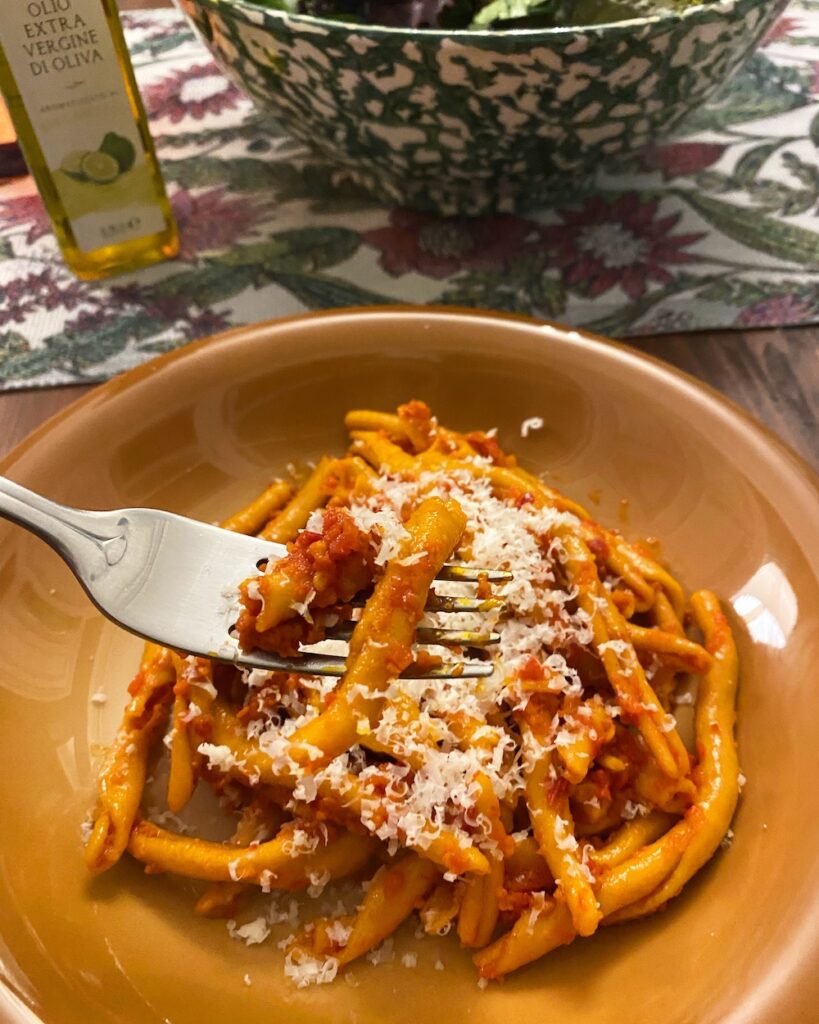
Ingredients (serves 2)
1 tablespoon of extra virgin olive oil
75g nduja
A handful of cherry tomatoes
1 tropea onion (or a small shallot if tropea onions are not available)
150g fileja pasta
Small glass of white wine
Pecorino to serve
Method
- Blend the tomatoes and red onion together and bring a pan of salted water to the boil.
- Add the extra virgin olive oil to another pan on medium heat; once it has heated, add the nduja and allow the fat to melt down.
- Meanwhile, add the pasta to the pan of boiling salted water.
- Add the tomato sauce to the nduja and simmer until it reduces.
- Then, add the wine and continue to simmer until it has evaporated.
- Drain the pasta once it has been cooked al dente and add it to the sauce with a little of the pasta water.
Serve with some pecorino if you like, and enjoy! Buon appetito!