
Monte Bianco – A Winter Classic Reimagined Through the Lens of Nature
There are desserts that do not belong to a single cuisine but to an emotional landscape. This Mont Blanc recipe, or Monte Bianco, is one of them. Born between Piemonte, Savoy, and Eastern France, it comes from the same valleys where people, ingredients, and traditions crossed long before borders existed. It is a mountain dessert, a winter dessert, a dessert of silence.
Mashed chestnuts, whipped cream, and a final snowfall of sugar: gestures that are simple, seasonal, and ancient. Mont Blanc has never been a spectacular dessert; instead, it is intimate — tied to home kitchens, slow rhythms, and the human need for warmth.
Perhaps for this reason, though never officially a Christmas dessert, it has always belonged to the holidays. A gentle finale, one that comforts rather than overwhelms. Chestnuts tell the story of humble cuisine turned identity; cream recalls snow, winter light, and reflection.
Mont Blanc is not technique — it is memory. A gesture repeated from generation to generation.
From Mountain to Forest: A Contemporary Reinterpretation
In this version, Mont Blanc does not lose its soul — it simply changes its point of view. The snowy mountain becomes a winter forest, another landscape of the season, rich with symbolism and mystery.
This dessert becomes a visual and sensory story of what happens at the foot of the mountain: the moss, the underbrush, the quiet life waiting beneath the snow.
The Pinecone: Form, Symbol, Structure
At the center of the plate rises a pinecone, assembled petal by petal with cocoa cereal flakes. The pinecone is not a decoration, but a symbol — of seeds, cycles, and stored light. It is the silent heart of the winter forest.
The structure that supports it is made from cocoa sponge cake crumbled and bound with whipped cream. A technique that gives volume while preserving moisture and softness.
The sponge cake has a humble purpose: to create shape, then disappear.
The cream — the essence of the traditional Monte Bianco — becomes architecture.
The Green Layer: Chestnut and Pistachio
The dessert rests on a green nest of chestnut-pistachio cream, evoking winter moss, alive even in the coldest months.
Pistachio is not used as a simple color accent. Its aromatic brightness cuts the sweetness of chestnut, giving the dessert freshness, depth, and balance.
The Flavor: Harmony, Depth, and Elegance
On the palate, this Mont Blanc is layered yet immediate. The sweetness of chestnuts, the creaminess of whipped cream, the gentle bitterness of cocoa, and the crisp contrast of the flakes coexist without competing.
A final dusting of powdered sugar recalls frost more than snow, closing the dessert with restraint.
This Mont Blanc recipe does not chase nostalgia or revolution.It is a respectful, contemporary translation of a winter classic — one that speaks of Christmas through landscape, ingredients, and time.
Contemporary Mont Blanc Recipe with Cocoa Pinecone and Chestnut–Pistachio Cream
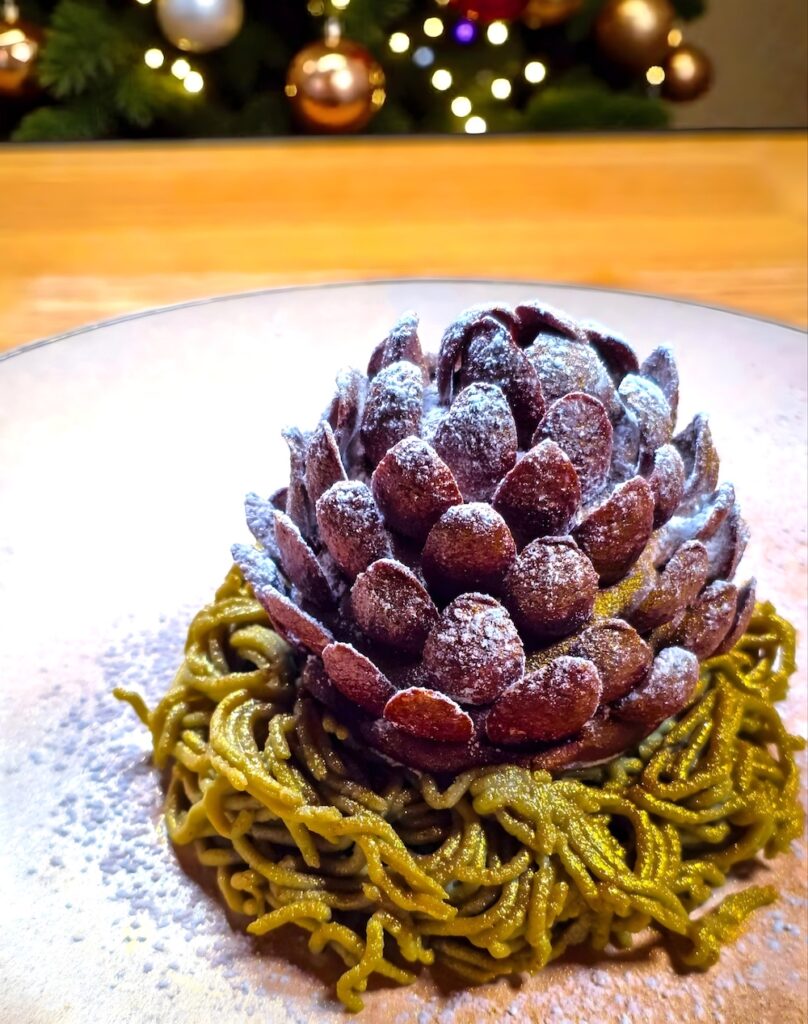
Ingredients (Serves 4)
Chestnut–Pistachio Cream
- 10.5 oz cooked and peeled chestnuts (300 g)
- 1/3 cup sugar (80 g)
- 1/3 cup whole milk (80 ml)
- 2 oz pure pistachio paste (60 g)
- 1 1/2 tbsp butter (20 g)
Cocoa Sponge Cake
- 2 eggs
- 1/3 cup sugar (60 g)
- 1/3 cup all-purpose flour (40 g)
- 2 tbsp unsweetened cocoa powder (20 g)
- Pinch of salt
Cocoa Whipped Cream (for binding)
- 2/3 cup heavy cream (150 ml)
- 2 tbsp powdered sugar (20 g)
- 1 tbsp unsweetened cocoa powder (10 g)
Soaking Syrup
- 3 tbsp warm milk (50 ml)
- 1 tsp rum or Marsala (optional)
For the Pinecone
- Cocoa cereal flakes, as needed
Finishing
- Powdered sugar
Method
- Chestnut–Pistachio Cream:
Blend chestnuts with warm milk, sugar, and butter until smooth. Add pistachio paste and mix well. - Cocoa Sponge Cake:
Beat eggs and sugar until pale and airy. Fold in sifted flour, cocoa, and salt.
Spread onto a baking sheet (½ inch / 1 cm thick) and bake at 340°F (170°C) for 10–12 minutes. Cool completely. - Cocoa Whipped Cream:
Whip cream with powdered sugar and cocoa until soft but stable. - Create the Structural Mixture:
Crumble the sponge cake, moisten lightly with the syrup, then combine with the cocoa whipped cream until compact and moldable. - Shape the Pinecone:
Form an oval cone and chill for 30 minutes. - Apply the Flakes:
Add cocoa cereal flakes one by one from bottom to top to create the pinecone effect. - Plating:
Create a nest of chestnut–pistachio cream using a piping bag or potato ricer.
Set the pinecone in the center and dust with powdered sugar.
Wine Pairing
Passito di Pantelleria DOC
Warm, enveloping, with notes of dried fruit, honey, and candied citrus — an ideal companion that enhances chestnut sweetness and balances cocoa bitterness.