
For the March issue of Live in Italy Magazine, we recognize Women’s History Month by highlighting women who take bold steps to shape their lives. In this edition of Chat with an Expat, I spoke with Stefanie Reilly, an Italian-Australian communications professional who made the leap of moving to Italy solo at 40.
What began as a personal journey to reconnect with her heritage ultimately led to the creation of To Italy and Back, a relocation service that helps others navigate citizenship, visas, and life transitions in Italy.
Our conversation touches on identity, family heritage, bureaucracy, and the realities of building a new life abroad — especially as a single woman taking a leap of faith.
You can listen to the full conversation on Italy Answered while following along with this edited transcript on Spotify, Apple Podcasts, or YouTube.
Where are you from? (01:58)

I’m from Australia and grew up in a country town called Shepparton, about two and a half hours from Melbourne, the capital city of Victoria.
My childhood was shaped by a mixed-race household. My father is Asian and my mother is Italian, so both cultures were always present alongside the Australian influence. It made for a very colorful upbringing.
My mother was actually born in Australia. My grandparents lived in Benevento in the region of Campania and migrated to Australia. My mum was born there soon after.
What reinforced your Italian heritage growing up? (03:11)
We spent a lot of time with my grandparents because they lived very close by. Weekends were often at their house.
My nonno was the quintessential nonno. He had the vegetable patch outside, and all the vegetables and herbs were grown there. Every year my nonno and nonna made tomato sauce, and the whole family was involved. They also made sausage, and there was always something hanging in the garage curing.
Food was a really strong part of our culture. It was when everyone came together. I remember Saturday night dinners at my grandparents’ house with the whole family. They were loud, colorful evenings, and my grandparents were happiest when everyone was together.
Growing up in Australia, some holidays like Easter weren’t always celebrated in a big way, but in our family it felt almost like another Christmas. There was always something to celebrate.
What led you to move to Italy at 40? (05:34)

A lot of people assume that when you move to another country it’s because you’re running away from something, but that wasn’t the case for me.
Nothing was wrong in Australia. I was close with my family, had wonderful friends, and my business was doing well. Still, something felt a little stale, as though something was missing.
Earlier that year I had traveled to Italy and, for the first time in a long time, felt truly alive and motivated again. When I returned to Australia, that feeling stayed with me.
Of course, holidays can feel romantic and exciting, but this felt different. There had always been a pull toward Italy because of my heritage, something that had been in the back of my mind for years.
As my 40th birthday approached, the opportunity to pursue Italian citizenship suddenly felt like the right moment to make a change. Four weeks after turning 40, I found myself living in a new country on my own without knowing anyone.
How did your family react to you returning to Italy? (08:10)
We actually laugh about it in my family.
My grandparents left Italy for opportunity, and now their grandchildren want to return. I think they did such a good job of sharing their culture with us that we grew up wondering what life in Italy would be like.
There’s a sense of curiosity when you grow up between two worlds. Italy felt familiar, but also different from the life I had known in Australia.
My grandparents have been very supportive. They haven’t traveled back to Italy much since leaving, so now they’re curious about what it’s like today. In some ways, they say I’ve seen more of Italy than they have.
What were the biggest challenges in obtaining Italian citizenship? (10:40)
The first challenge was simply determining the right pathway. I was fortunate to qualify for citizenship by descent, but the process was still very complex.
Getting an appointment at the Italian consulate in Australia can be extremely difficult because they’re overwhelmed with applications. In the end, applying directly in Italy seemed like the better option.
Early in the process it became clear that professional help was necessary. That’s when I found a lawyer named Valentina, who now works with me in my business, and she helped guide me through the bureaucracy.
At one point the laws changed halfway through my application, which meant switching the family line I was using. That required searching for entirely different documents and also brought up emotional aspects of family history.
There were moments of doubt about whether it was the right decision. Important events had to be missed, including a close friend’s wedding, because traveling to Italy earlier than planned became necessary.
Still, the excitement about what was ahead kept me focused on the bigger picture.
Why did you choose Puglia? (14:05)

Originally, the plan was to move to Florence.
Valentina is from Lecce in Puglia, and she explained that applying there could mean obtaining my passport in about half the time. She also described Lecce as the “Florence of the South.”
Until then I had never been south of Rome, so I spent a day researching Lecce and immediately thought it looked beautiful. Trusting her advice, the decision was made to go for it.
Arriving there, it was easy to fall in love with the city. Looking back, it still feels surprising to think about arriving without knowing anyone, but somehow everything worked out.
How did “To Italy and Back” begin? (16:00)

During the citizenship process, Valentina was incredibly supportive. She even met me when I arrived in Italy, had groceries waiting at my house, and left a small cake and a note for me.
That experience led to a genuine friendship.
After completing the citizenship journey, it became clear how much I had learned and how confusing the process can be for others. From there, we decided to help people navigate it together.
This keeps the spoken feel, reduces repeated “I” starts, and remains clear for non-native readers, which is ideal for a transcript format.
Our Clarity Calls are designed to help people understand their options. There is so much information online that people often feel overwhelmed. We look at their individual situation, whether they’re eligible for citizenship, what visa options might exist, and what their long-term goals are.
From there, Valentina handles the legal side of citizenship, while we also help with relocation planning and settling into life in Italy.
What advice would you give someone preparing to move to Italy? (20:23)
I think it’s important to arm yourself with information, but also to immerse yourself in Italy even before you arrive.
While still in Australia, I started learning the language. Shows about Italy, books, and daily practice on Duolingo became part of the routine.
Understanding the culture and communication style makes a huge difference. Communication isn’t only important with lawyers or officials — it’s also important in everyday life with neighbors, shopkeepers, and other expats.
Immersing yourself in the culture early helps make the transition smoother.
How can someone moving alone build community? (22:58)
One of my biggest fears before moving was not making friends.
After arriving in Lecce, I posted in a local expat Facebook group saying I had just moved there and would love to meet someone for coffee. Within a day, several people responded.
One of the first people I met eventually became one of my closest friends.
Many towns have communities for remote workers, digital nomads, and expats. Before moving, I had already joined several online groups so I could understand what communities existed.
If you’re moving alone, building that network is incredibly important.
What is your definition of an expat? (28:21)
For me, an expat is someone who feels there might be something different for them somewhere else, and they choose to explore that feeling.
It doesn’t mean life will necessarily be better, but it means you’re willing to take a risk and see what’s possible.
And if you decide it’s not for you, you can always return home.
What do you miss about Australia — and what do you miss about Italy? (29:48)
I’m a big foodie, so one of the things I miss most about Australia — particularly Melbourne — is the incredible variety of cuisine. Great Asian food is something I especially miss.
Australia also has a certain modern polish that I appreciate when I return.
At the same time, being back in Australia makes me realize how much I miss Italy’s slower rhythm, especially life in Puglia. There’s a sense of calm here. Everything feels less frantic and more present.
Interestingly, my family has noticed that difference as well.
What message would you share for Women’s History Month? (33:20)
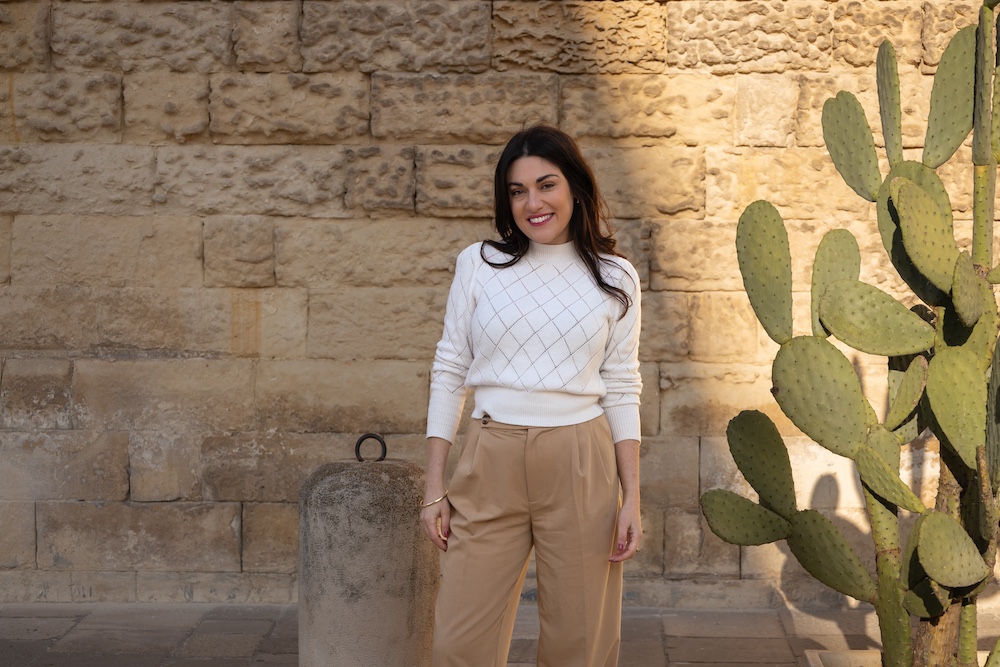
I would say go for it.
If you’re thinking about doing something different — whatever that might be — take the risk and try it.
Don’t worry about age or timelines. You can create your own timeline.
If that voice inside you is telling you to do something, listen to it.
Connect with Stefanie Reilly
www.italyandback.com
Instagram: @italyandback
foxandfleur.com.au
For more conversations like this, listen to Italy Answered and explore the Chat with an Expat series by subscribing to Live in Italy Magazine.