Cenci, Chiacchiere, Frappe: All the Names of Italy’s Carnival Sweet

Chiacchiere are the traditional dessert of Carnevale. With ancient roots and many regional names, they appear on tables and in pastry shop windows all across Italy during the Carnival season.

Like many traditional recipes, their origins are old. What makes chiacchiere especially fascinating is that nearly every region calls them by a different name.

Let’s discover them together.


Origins and Legends

The origins of chiacchiere date back to Ancient Rome. At the time, they were known as fritcilia and were fried in pork fat. Large quantities were prepared during the Saturnalia, a festive period that, in Christian tradition, later aligned with Lent.

The word chiacchiere literally means light conversations among friends.

There is also a popular anecdote tied to Naples. According to legend, a Queen of Savoy, after a long afternoon of conversation, suddenly felt hungry. She asked the court cook to prepare something small to eat “between one conversation and another.” From that moment on, the sweets became known as chiacchiere.

True or not, the story adds charm to a dessert already rich in tradition.


Chiacchiere di Carnevale: Many Names, One Sweet

Over time, chiacchiere became the symbolic sweet of Carnevale. Today, they are prepared in every region of Italy and identified by different names depending on where you are.
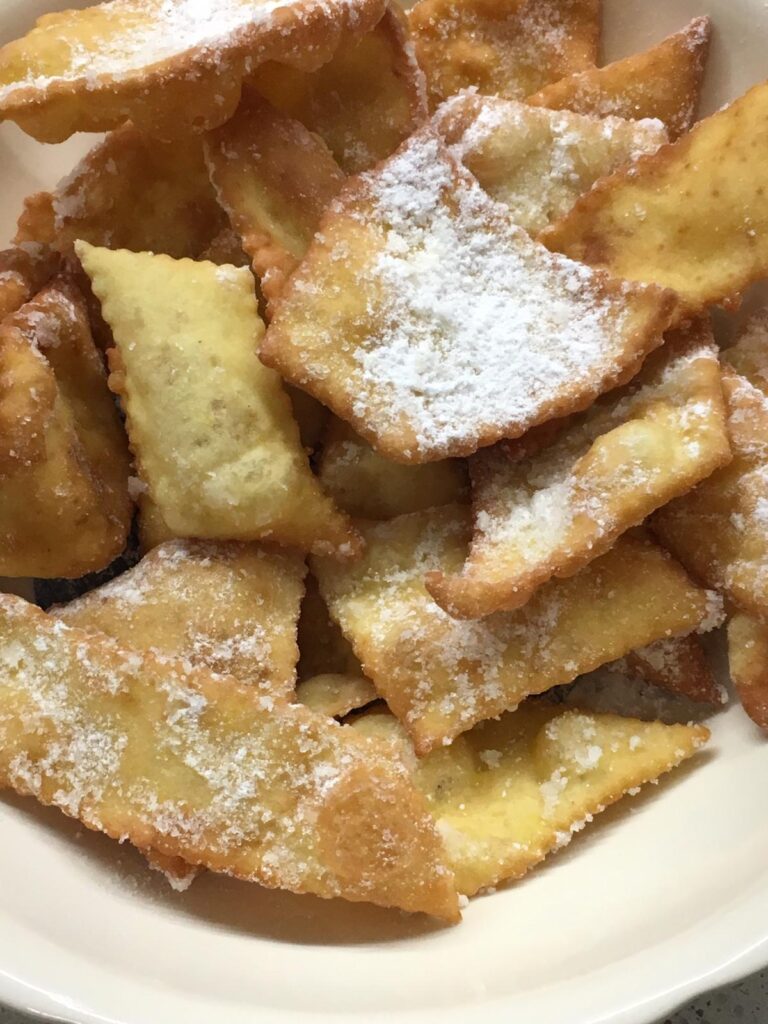
Photo © Chiara Borghesi


In Piemonte, they are known as bugie—which literally means “lies.” Perhaps chatting too much leads to telling a few bugie. In Vercelli, they are also called gale.
In Valle d’Aosta, they go by the elegant name merveilles.


From North to South

You’ll also find bugie and chiacchiere in Liguria.

In Lombardy, they are known as galarane in Bergamo and lattughe in Mantua. Across Veneto and Trentino, the same sweets take the names gròstoli or galani, particularly in Venice.

In Emilia-Romagna, names change again: fiocchetti in Rimini and sfrappole in Modena, Bologna, and Romagna.

Moving further south, we encounter frappe in Lazio, Umbria, and Marche, cioffe in Sulmona and central Abruzzo, guanti in Caserta, and maraviglias in Sardinia.


And in Central Italy? Welcome to Tuscany

In Tuscany, where imagination is never lacking, chiacchiere are called cenci.

When I return to Siena at this time of year, I have already shared with you the secrets behind another Carnival favorite, the famous frittelle of Piazza del Campo. You can read more about them here and here as well.

Now, let’s take a closer look at another protagonist of the Tuscan Carnival table: i cenci.

Why Are They Called Cenci?
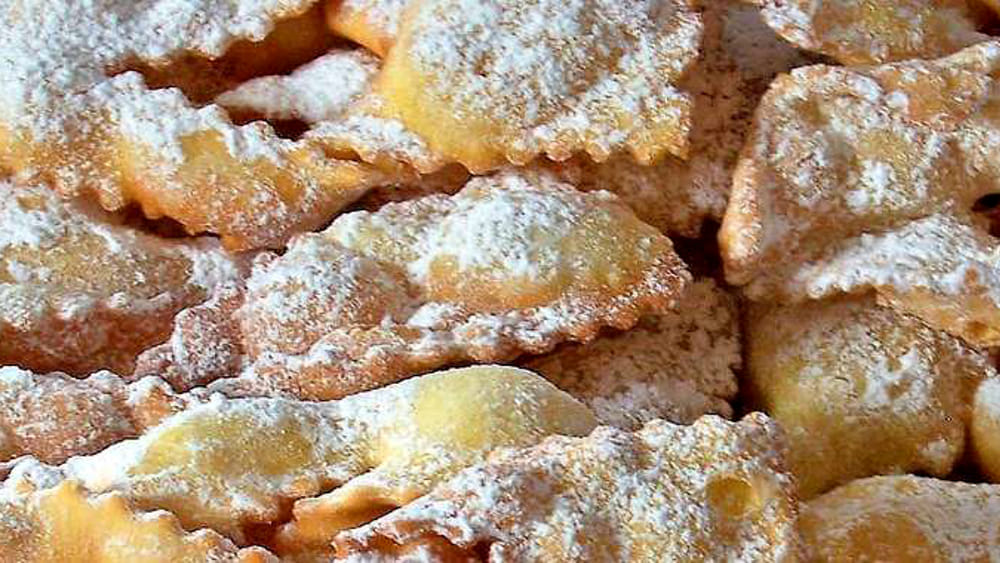
The word cencio in Italian refers to a piece of fabric with little value—a rag. It is an old word still commonly used in everyday Tuscan language. You might hear expressions like un cencio per pulire il pavimento or un cencio per togliere la polvere.

These sweets do, in fact, resemble thin pieces of fabric.

Wherever you go in Italy during Carnevale, cenci—or whatever they are called locally—dominate bakery windows. They are simple fried dough, generously sprinkled with sugar.

Sometimes, simple is all you need.


Vocabolario di Carnevale

  • Chiacchiere – chit chats
  • Cencio – rag
  • Bugie – lies
  • Carnevale – Carnival
  • Fritto – fried
  • Impasto – dough

Chiara Borghesi

Contributor & Language Expert

Chiara Borghesi is a translator, Italian teacher, content creator and free-lance writer of Italian language and culture. Born in Siena, she lived for many years between the United States, England and around Europe before returning to her native Tuscany where she lives with her "multilingual" family. After 20 years of organizing study holidays, cultural trips and teaching Italian with her exclusive experiential learning method, she returned to Siena where she created Chiara's Tuscany Experiences: not a traditional Italian school. Chiara promotes language learning through emotions, story telling, online creative activities and practical live experiences with exclusive full immersions. A free-lance writer, she also collaborates with magazines, radio programs and podcasts in other countries to broadcast her passion for the Italian language, culture and lifestyle around the world. Passionate about words and communication, through her courses and social media, she shares with her readers and students, stories and meanings of curious expressions. Her goal is to make you fall in love with Italy and its language and, why not, understanding Italians’ mind too.

No Comments Yet

Leave a Reply

Your email address will not be published.

Live in Italy Magazine is an experiential travel and lifestyle magazine dedicated to all things Italy. Monthly features: “Chat with an Expat” – a in depth conversations with people who have moved permanently to Italy. “Italy Answered” our Spotify podcast features Italians with special stories and more. We are committed to authentic and sustainable travel and spotlighting “Made in Italy”.
Named the Best Italy Magazine by Feedspot for two consecutive years!

We feature in-depth articles and interviews covering:

  • Expat Life
  • Food & Wine
  • Travel
  • Lifestyle
  • Design, Art, & Culture
  • Real Estate, Hotels/Resorts & Long-Term Rentals

We are committed to creating great content. Please consider becoming a Sponsor by donating on Patreon

Thank you for your support!

Our Contributors:

Lisa Morales, Editor-in-Chief (Miami)
Christine Cutler, Travel Editor (St. Petersburg, FL)
Lorenzo Diamantini, Food Editor (Gubbio)
Adriana Suarez, Top 8 Editor, Social Media Manager (Miami)
Angie Kordic, Visual Arts Guest Contributor (Sweden)
Feuza Reis, Guest Contributor (Miami)
Patrizia Vigolo, Wine Contributor (Vicenza)
Natalia Bell. Food Contributor (Scotland)
Emma Prentice, Guest Contributor (UK)
Chiara Borghesi, Contributor & Italian Language Advisor (Siena)
Annalucia Scotto Di Clemente, Guest Contributor (Rome)
Dennis Woudt, Guest Wine Contributor (Netherlands)
Jemma Fowler, Guest Contributor (UK)
Paola Cirino, Guest Contributor (Napoli)
Justin Patulli, Contributing Editor (Canada)
Sara Bauer, Contributor (Milan)
Valentina Salcedo, Contributor (Trieste)
Piera Demartis, Guest Wine Contributor (Sardegna)
Reginald Dunlap, Interior Design and Luxury Lifestyle Contributor (Miami/Noto)
Raluca Kotowski, Contributing Photographer & Storyteller (Miami)
Sandra Diaz-Velasco, Architecture & Design Contributor (Miami/Colombia)

Al Esper Graphic Design: Digital Edition Art Director (Tennessee)
Profit.Mov–Content Creation: Aaron Morales & Caitlin Watson (Miami)
SQLHardhat: Aaron Morales, Website Design and SEO (Miami)
Visual Popcorn: John Craven, Video Editor (Miami)
“Italy Answered” Podcast Editor, Charles Dike (Estonia)
Sabrina Negro, Translator (Piemonte)
Giulia Ferro, Subtitler EN/IT (San Michele all’Adige)

Sales: sales@liveinitalymag.com

Submit Your Press Release: lisa @ liveinitalymag.com

Guest Contributors:

Guest Contributor applicants should have a good understanding of WordPress. Email links to recent articles along with your social media handles to: lisa @ liveinitalymag.com.